




After a day of training at the Sai Sports Academy in Madhya Pradesh’s Chhatarpur town, Pinky Ahirwar, 18, starts walking her bicycle back with a group of girls and boys, all teens. The cycle belonged to her older brother who got it from the State government five years ago, after he finished Class 10. “I used to come for practice by a shared auto-rickshaw, which cost ₹40 daily. So, I got the bicycle fixed and saved that money to spend on my diet instead. That helps me in training,” she says.
She has been training at the academy for about one and a half years. Her diet involves chana (chickpea) and banana — staple sources of protein and energy for young athletes training in rural northern India.
As Ahirwar’s village, Dhidhonia, is about 35 kilometres from Chhatarpur, she stays in a rented room with her brother and sister, who are in college. Ahirwar, however, quit studies after school to focus on cricket training.
The academy in Chhatarpur, a small town in the poverty-ridden Bundelkhand region, is run by Rajeev Bilthare, who started it in 2013. He began training girls from 2016. It produced the pacer, Kranti Goud, who was part of the team that won the ICC Women’s World Cup, 2025, on November 2. Goud, a 22-year-old tribal girl from a rural town about 85 km from Chhatarpur, was among the first batch of women cricketers at the academy when she joined in 2017. “Now at least 60 young players train at the academy, including about 20 girls,” Bilthare says.
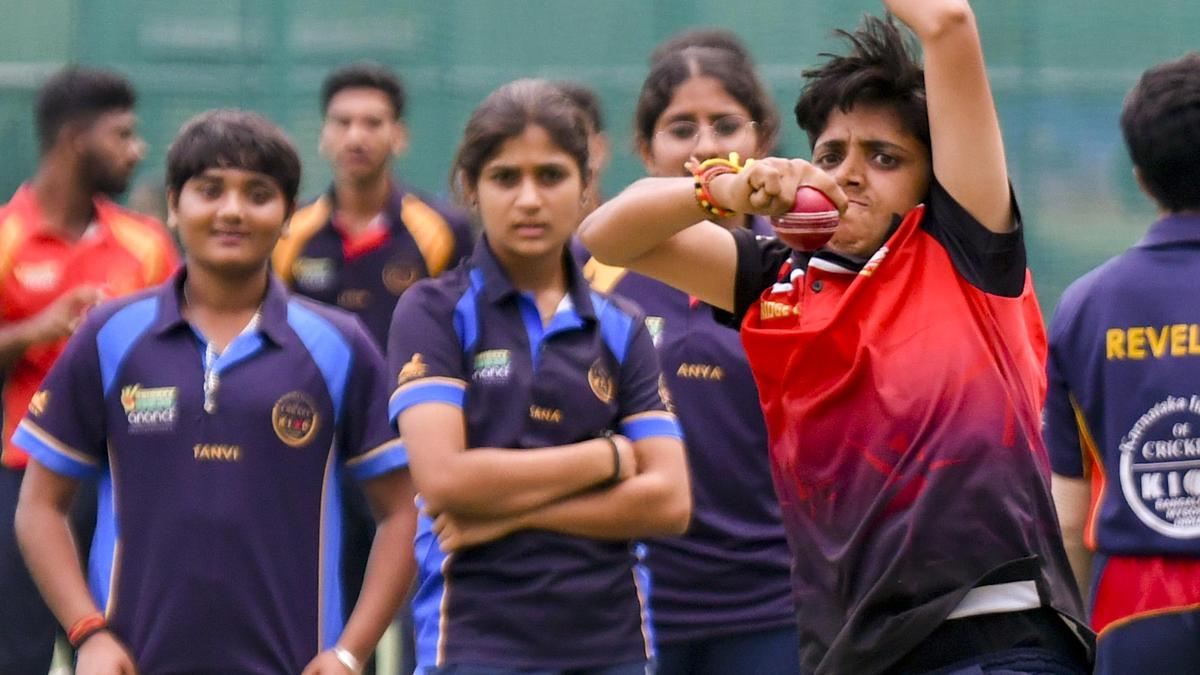
Girls practising at the Sai Sports Academy in Madhya Pradesh’s Chhatarpur town.
| Photo Credit:
A.M. Faruqui
It is not just in Madhya Pradesh; girls and women across India are playing cricket professionally, inspired by the tremendous growth of the game. Before the World Cup, BCCI secretary Devajit Saikia had said, “This event will give more encouragement to our women and our girls to take up cricket in a more serious, competitive manner. And they will see a proper and secure future in their career.”

In Haryana’s Shri Ram Narain Cricket Club, coach Ashish Parmal says he got more than 30 calls from parents the day after the World Cup final, asking whether they could enrol their daughters. This was where national cricketer and India’s highest scorer in the final match in the world cup, Shafali Verma, first trained.
In Chennai, Prithi Ashwin, who spearheads the Gen-Next Cricket Institute along with her husband, cricketer Ravichandran Ashwin, says the academy received 10 calls from parents asking about coaching during the World Cup.
Irfan Sait, Head Coach and Managing Director of the Karnataka Institute of Cricket (KIOC) in Bengaluru, who has been part of the State’s cricketing ecosystem for over four decades, says there has been a “sea change” in women’s cricket. Sait has trained many women players including Mamatha Maben, Nooshin Al Khadeer, Karuna Jain, who were all part of the national team.
Despite this “sea change”, many coaches still measure a girl’s ability against a boy’s. At an academy in Bengaluru, one of them says, “When I coach a 19-year-old woman, I often evaluate her against the standard of a 16-year-old boy.” Girls are also still a fraction of the players at academies. As Ashish Parmal, a BCCI Level A coach at an academy in Haryana, says, “We train 31 girls in Rohtak and 62 in the Gurgaon centre, both of which boast a collective strength of over 500 boys across Under-15, Under-19, Under-23 and Senior categories.”
Fields of promise
Around 4 p.m., eight girls and at least 15 boys, from ages 8 to 22, gather at the academy in Chhatarpur. It is run out of a rented ground, converted from a field, with uneven grass in parts and trees along the sides.
There are four nets in a corner, one of them occupied by three girls. Other players are scattered across the ground, stretching or working on their batting stance or bowling action. A group of players, including three girls, is practising at the pitch.

Bharti Verma, 17, a medium pacer who attended a national-level under-17 camp, charges in to deliver a ball. Her shoes, with screw-on spikes, are worn out. Her father, a farmer, who sustains a family of six, bought them for her about two years ago for ₹1,500. Now, a basic pair would cost at least ₹2,000, she says.
Verma says her father has promised her a new pair. “I have been training here for five years and my parents have been supportive. Whenever I have asked them for cricketing gear, they have always managed to arrange it for me, even if it takes some time,” she says, adding that she recently injured her ankle while playing in her regular shoes.
Sukhdeep Singh, 24, an assistant coach and a player, says it is tough to run an academy. He lists several infrastructural problems, like there being no covers to protect the pitches from the rain or dew. In the long list of don’t-haves are washrooms and a dressing room. “Until a year ago, we were running the academy next to a private school so players could use the toilets there,” he says. Now, players go to a house next to the ground.
Bilthare, who is also a sports officer at a local government college, says that there has been “absolutely no help” from the authorities. “I started a girls unit in 2016 with five girls, and ran camps across colleges and schools in the area to attract more girls for a year. I managed to put together a squad of about 20. I bought them two kit bags and began training them. It was the only one for a few years in the entire Sagar division,” he says. He is hoping for a ground lease from the government.
Bilthare says, “Many players train here for free. Kranti was also enrolled for free when she first came. It is not possible to buy expensive equipment and invest in infrastructure with just fee income.”
“Some girls from here are playing at various levels — from the division to the State level. A girl is also playing a T20 tournament organised by the BCCI. Our players have talent to go further if they get the right support and resources,” he adds.
Irrespective of the lack of resources or of being outnumbered by boys, girls continue to follow their passion. Vaishnavi Pal, 18, joined the academy on November 5. “I started playing with my brother and cousins in our colony, but the neighbours objected. So, we moved to a ground nearby. A local coach saw me and encouraged me to join his academy. I trained there for five years before coming here,” says Pal.
A resident of Shivpuri district, Pal has come to stay at her aunt’s place for better access to the club. Her mother recently won a three-year battle against cancer. “My parents asked me to focus on the game,” she says.
Self-consciousness to self-confidence
At the Cricket Mantras Academy in Nahur, a Mumbai suburb, a group of girls pad up under the watchful eyes of coach Swapnil Pradhan. The crack of the ball meeting bat and the chatter of girls and boys fills the air.
Among the trainees is Diksha Pawar, 19, an off-spinner who has represented Mumbai in the Under-19 team. Pawar says her journey began by chance. “When I was a child, I liked sports, mostly basketball,” she says. “But my dad had enrolled my brother in a cricket academy. When I saw the boys play, I told him, ‘I want to play too.’ Soon, I joined the same academy. There were almost 100 boys; I was the only girl. At first, it felt strange. But over time, I got used to it. It became normal.”
The early self-consciousness soon gave way to confidence. “I remember one match where I scored 20 runs and took two wickets against boys. That is when I felt I could belong; that I could play this game not as a girl, but as a cricketer,” she says.

Pawar’s idols include Deepti Sharma and Jemimah Rodrigues, who were both part of the winning World Cup team. Rodrigues is the daughter of Pawar’s first coach. “Jemi used to practise in Bhandup [another suburb] back then. I was also practising there,” she recalls. “She always pushed herself, no matter how things were going. She believed in herself. Her belief and optimism came through in her semifinal knock. That is what I want to learn from her.”
For Arya Davane, 15, who has represented West Zone Under-17 and was selected for the BCCI off-season camp at the Centre of Excellence in Bengaluru, the journey began with defiance. “In 2022, during a practice match against the boys, one of them said, ‘She is a girl; she will get out soon,’” Davane recounts. “That hurt. I scored just 10 and got out early. But I told myself, ‘I will show them that I’m just as capable’.” Davane’s role model is Australia’s leg-spinner Alana King. “I saw her bowl during the World Cup. I hope to bowl like her someday,” she says.
The coach, Pradhan, believes this new generation of girls is at a turning point. “When India won the Men’s T20 World Cup in 2007 and the Indian Premier League began, Indian cricket exploded. Something similar is happening now — the Women’s Premier League [that began in 2023] and the World Cup win are catalysts. There are plenty of opportunities and that is drawing more girls and parents towards the game. Soon, competition will rise, more teams will form, and the ecosystem will grow stronger.”
Cricket Mantras runs a Gulf Oil-sponsored batch of 12 girls, including Pawar and Davane. “The structure is improving,” Pradhan says. “But we need to make sure coaching, scouting, and exposure grow in tandem.”
In Thane, north-east of Mumbai, coach Kiran Salgaonkar echoes that sentiment. Having mentored female cricketers for over 25 years at the Salgaonkar Cricket Academy, he says, “If match fees for women are still far below that of men, it is unjust. The girls put in the same amount of work and are just as dedicated. The rewards should be equal too.”
Sources of motivation
In Kolkata, the Pal and Chatterjee Cricket Academy (PCCA), situated at Vivekananda Park in Sarat Bose Road area, is a prominent hub for women cricketers. Founded by cricketers Pankaj Pal and Utpal Chatterjee (not the former India player) in 2009 with just two boys, PCCA, which relies on tuition fees, corporate funding, and donations, began enrolling girls in 2014.
According to Pal, the number of girls stands at close to 100 now and around 30 of them have made it to different Bengal teams. Sukanya Parida, who trained here, has donned the India colours. The PCCA conducts matches involving mixed gender teams. “We give equal attention to both boys and girls, but for the girls, coaching is free,” says Pal.
Adrija Sarkar, 14, an all-rounder, idolises former cricketer Jhulan Goswami. “My aspiration is to represent my country. Watching our women’s team becoming the world champions has inspired me,” she says.
Sarkar’s mother Mousumi Deb Sarkar feels the inflow of money has made women’s cricket a lucrative career option. “Being financially secure is important. Hearing that Richa Ghosh [a World Cup winner] is getting so many crores of rupees is a big motivation,” she says.
Upasana Ghoshal doesn’t have apprehensions about her five-year-old daughter Adrika’s safety during practice sessions. She says she prepares her child to stay safe, telling her how to react to certain situations.
PCCA has several young and experienced coaches who focus on their trainees’ basics. Pal remembers, “When we began girls’ coaching in 2014, we found only a few players. Now, clubs conduct trials to select girls for admission.”

Playing despite taunts
On Jhajjar Road in Rohtak district stands the 30-year-old Shri Ram Narain Cricket Club. Between 3 p.m. and 5 p.m., its indoor net practice arena gets filled with trainees wearing the academy’ blue uniforms. Among them is Sneha Jhakar, 18, a right-arm pace bowler. She says her brother was once an aspiring cricketer but because they didn’t have money for both of them to play, he took a job and fought within their joint family to get her enrolled in this academy.
Across the ground, is Sonia Mendhiya, 21. Hailing from Bahmanwas village in Haryana, Mendhiya was the only girl who played gully cricket with boys from the age of 10, despite her mother’s objections and neighbors’ taunts.
“One of the boys told me about this academy, and I joined without thinking twice,” she says. Two years ago, she played for the winning Indian U-19 Women’s T20 World Cup team under Shafali’s captaincy.
Though her village is only about 12 km from the academy, Mendhiya endured a long journey to train from the age of 14. After her father died early, her mother, an Anganwadi worker, raised four children alone. When Mendhiya joined the academy in 2018, the annual fee was ₹31,000; now it is ₹92,000. The academy waived her fee for the initial years and with training, Mendhiya soon started playing tournaments. About five years ago, she spent her first match fees buying better quality bats for herself. Over the years, she has managed to pay her own academy fees, buy a scooter, and renovate her home. “The same people who taunted my mother for ‘wasting money on a boy’s sport’ later said I was an idol for their children,” she recalls. But even after her success, the comments haven’t stopped. “Now they don’t taunt my game,” she says. “They question why I wear shorts to the gym.”
With no hostel at the academy and parents unwilling to let their daughters stay alone in rented accommodation, a few travel at least three hours every day to train here. Suman Sandhu, 21, comes from Karnal; Sneha Jakhar, 18, from Fatehpur; and Aishika Gautam, 16, from Hisar.
Sandhu earlier played cricket with her brother, who quit for higher studies. She had to wait for two years before getting her own cricket kit and moving to this academy for better facilities. “Parental support comes only after good performance,” she says.

Despite Haryana’s strides in women’s education and sports, stereotypes hang heavy. Chahat Grewal, 13, admires T20 captain Harmanpreet Kaur. “People ask why we’re learning boys’ sport,” she says. “Even on social media, one bad match and they tell you to go back to the kitchen. We don’t get the same support unless we win medals or score runs.”
However, women in Haryana have built resilience because of their successes in sport. Coaches say nearly every Haryana district now has 40–50 girls playing cricket. “District-level competitions by Haryana Cricket Association are for boys only,” says coach Bijender Sharma. Girls need these matches too.”
Sandhu remembers beginning training in Karnal at 19. She threatened to quit school if her parents didn’t register her. “It worked,” she says, laughing.
With inputs from Rishita Khanna in Bengaluru and Sanjana Ganesh in Chennai