






The story so far: The Periodic Labour Force Surveys (PLFS) have been monitoring the gender earnings gap across various forms of employment from April-June 2019 to 2023. This latest round has introduced a crucial focus on weekly hours worked, revealing that the inequality in total earnings might not capture the full picture. Women, on average, work fewer hours than men, attributed to a combination of social pressures and personal choices, highlighting the complex interplay between societal norms and individual decisions in shaping gender disparities in the workforce.
How does the gender earnings gap differ?
The Nobel prize-winning work of Claudia Goldin focused on the technological, social and institutional factors determining inequalities between men and women in America. Such work has resonance for India as well, where there exists a vast literature by Indian scholars examining the many disparities in work participation and wages affecting working women.
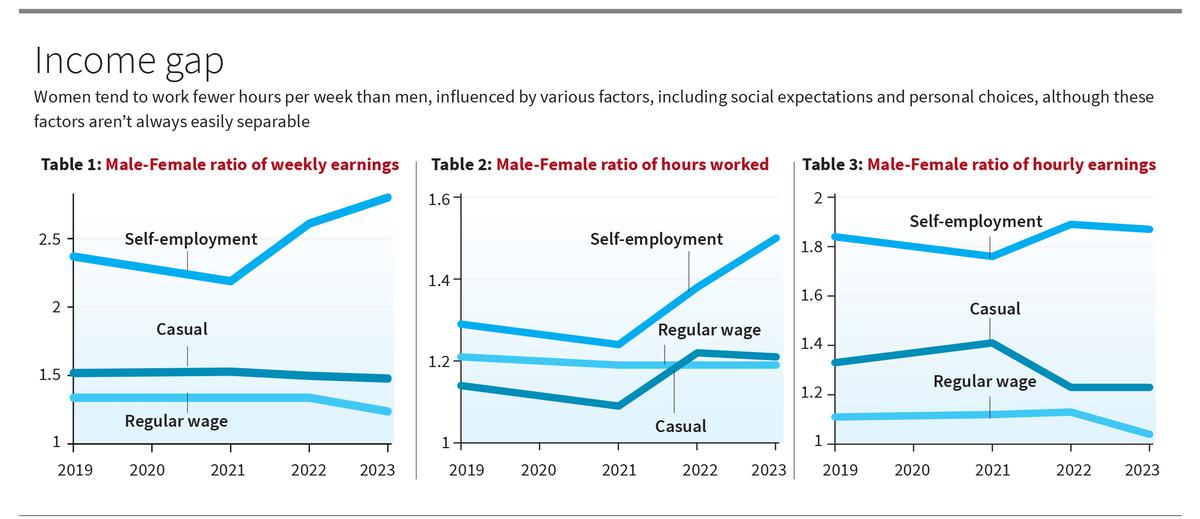
Earnings for all types of workers are converted to weekly figures. Table 1 shows the ratio of weekly earnings for men and woman at the all-India level – aggregating across rural and urban sectors – from the quarter April-June 2019 to April-June 2023. A figure above 1 indicates greater men’s earnings relative to women: a figure of 1.24, for instance, indicates that men’s earnings are 24% greater than that of women.
Men earn more than women across all forms of work, the gap greatest for the self-employed. In 2023, male self-employed workers earned 2.8 times that of women. In contrast, male regular wage workers earned 24% more than women and male casual workers earned 48% more. The gender gap in earnings is still a persistent phenomenon.
However, there are differences in trends. The gender gap has increased for self-employed workers, while falling for regular wage workers. Male regular wage workers earned 34% more than women from 2019 to 2022, with the gap falling to 24% in 2023.
Are there any notable differences in the average weekly work hours?
These gaps do not fully indicate inequalities in earnings per work effort, for women work lesser hours per men during the week across all forms of work, as shown in Table 2.
In 2023, the gap in work hours was largest for self-employed workers, where men worked 50% more hours than women, and lowest for regular wage workers (19%). Though the gap was the smallest, men and women in regular wage workers worked the longest hours, at 51 and 43 hours per week respectively. While the ratio is roughly constant for regular wage workers, there is a huge increase for self-employed workers.
The rise in the gender gap in hours worked alongside rising self-employment for women requires explanation. Labour force participation rates (LFPRs) for rural women have increased, with a significant rise in the proportion of self-employed women. Simultaneously, the average hours worked per week for rural self-employed women has fallen from 37.1 in 2019 to 30.1 in 2023. This indicates that much of the increased employment for rural self-employed women has been part-time in nature, in contrast to men’s full-time work. Meanwhile, the ratio of hours worked for regular wage workers stayed roughly constant.
Using data on weekly earnings and hours worked, earnings per hour for each category of workers are calculated, and the ratio between men and women’s hourly earnings are displayed in Table 3.
What is the percentage decrease in the gap in hourly earnings?
When considering hourly earnings, the gap reduces significantly for regular wage workers. In 2023, men in this form of employment earn 24% more than women over the week, but also work 19% longer. The gap in hourly earnings, therefore, is only around 4%, falling from 11% in 2019.
On an average, women in regular work earn lesser per week, but roughly the same when one considers earnings per hour. Of course, averages hide significant disparities, and greater research is required to see whether the gap in hourly earnings are the same for all workers, across all occupations and industries.
Inequality in hourly earnings is higher in other forms of work, though not as high as when considering total earnings. In 2023, male casual workers earned 23% per hour more than women, a reduction from 33% in 2019. The gap has increased slightly for the self-employed, from 84% in 2019 to 87% in 2023.
This allows us greater insight into the forces driving changes in inequality over this period. Consider regular wage workers. Falling inequality in weekly earnings was largely driven by rising hourly earnings for women, with the ratio of hours of work remaining roughly constant.
In contrast, rising inequality amongst the self-employed was driven by changes in hours worked. The influx of women into part-time work reduced their average hours of work. With men working relatively longer hours, and with the ratio of hourly earnings remaining constant, inequality in total earnings increased.
What influences hours of work?
Lower inequality in hourly earnings for regular wage workers does not imply that inequality is the outcome of women choosing to work lesser hours, for the option of greater working hours may not be available. Working hours are not always the outcome of a pure and unconstrained choice, and social norms that require women to attend to domestic and child-rearing duties might leave them little choice but to seek out jobs with fewer hours.
It is important not just to understand the factors driving differences in remuneration, but also those that determine differences in total hours of work. Policy must look to removing barriers that limit the hours of work available to women. This can take the form of interventions within the workspace – for instance, mandating creches and more generous maternity leaves – to more comprehensive transformations in social norms that do not place the entire burden of child care and domestic work on women.
(Rahul Menon is Associate Professor, Jindal School of Government and Public Policy, O.P. Jindal Global University)