




When the state of Israel was declared in May 1948 in Palestine, five Arab countries attacked the newly created state, launching the first Arab-Israeli war. In the subsequent months, some 7,00,000 Arabs from Palestine, mostly from areas that became part of the Jewish state, were uprooted from their homes. Most of them took refuge in Gaza, a tiny Mediterranean strip of land, and the West Bank, the land on the western bank of the Jordan River. As refugees started flowing into Gaza, the 356 sq. km territory saw its population swelling to over 2,00,000 within months. In the war, Israel captured more Palestinian territories than what the UN partition plan had envisaged for a Jewish state. Jordan seized the West Bank and East Jerusalem and the Gaza Strip fell into the hands of Egypt.
Also read: Will Israel’s Gaza offensive stop Hamas? | Explained
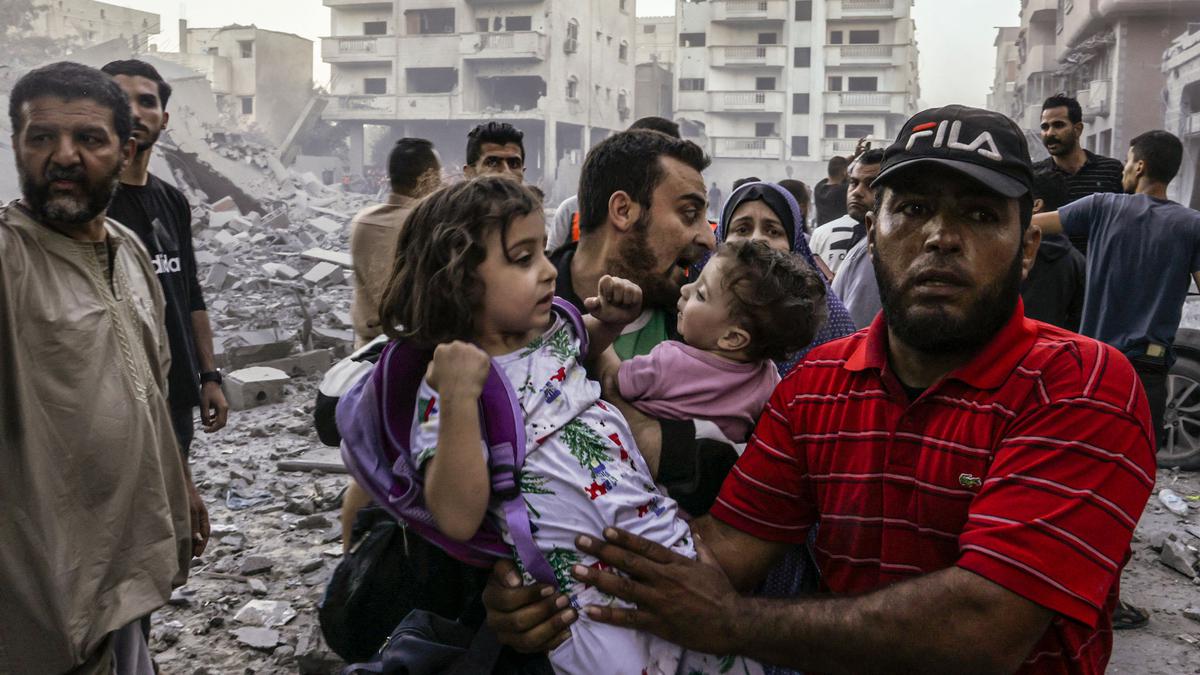
The people of Gaza, who lived under Ottoman rule for centuries and British occupation for decades subsequently, would continue to see their fate being determined by colonisers. Israel would capture the enclave in 1967 and keep it under its control, either through direct military occupation or blockades. Gaza has remained a flashpoint ever since, with occasional bouts of violence. The latest in this episode was the October 7 Sabbath attack by Hamas, the Islamist militants who control Gaza today, that killed at least 1,400 Israelis, mostly civilians. In retaliation, Israel has launched a massive bombing campaign, already killing some 4,000 people, and is now preparing for a ground invasion.
History of Gaza
When Palestine was incorporated into the Ottoman Empire in the 16th century, it was divided into six administrative districts. Gaza Sanjak (District of Gaza) was one of them, stretching from Jaffa in the north (now part of Israel) to Rafah (now, the border crossing with Egypt) in the south. For over four centuries, it remained an Ottoman district of Palestine.
From the early 19th century, Jews, fleeing discrimination in Europe, had started migrating to Palestine. In 1917, during the last leg of the First World War, the British captured Palestine, including Gaza, from a crumbling Ottoman Empire. In the same year, the British had promised to support the creation of “a national home for the Jewish people” in Palestine. After the war, Palestine, comprising today’s Israel, West Bank and Gaza, became a British colony. Jewish migration to British-ruled Palestine would pick up pace during the interwar period. This would lead to Arab-Jewish violent riots in the 1930s.
Also read: Why did Hamas launch a surprise attack on Israel? | Analysis
By the time the Second World War was over, Jews had become a sizeable community in Palestine with a parallel administration, the Jewish Agency, and their own militia groups — Haganah and Irgun. Britain approached the UN, declaring its intent to vacate the mandate. The UN partition plan — divide Palestine into an Arab state, a Jewish state and an international city of Jerusalem—was rejected outright by the Arabs. In 1948, just before the British mandate ended, Zionists unilaterally declared the state of Israel, which triggered the 1948 war.
Under the Israeli occupation, there were two different streams of Palestinian movements—the secular nationalism championed by Fatah and the Palestinian Liberation Organisation (PLO), and the Islamist awakening promoted by the Muslim Brotherhood. In Gaza, the Brothers had established deep roots. In both Palestinian territories (the West Bank, including East Jerusalem) and Gaza, public anger was building up against Israel’s occupation. And Gaza played a major part in the outbreak of the first intifada (uprising) against the occupation. On December 8, 1987, several Palestinians were killed in a traffic incident in Gaza, involving an Israeli driver, which immediately led to a wave of protests, which spread to the West Bank. The PLO called for a mass uprising. A year later, Hamas was established.
The intifada would eventually lead to the Oslo Accords of 1993 which saw a provisional authority (the Palestinian Authority) being formed with limited powers in certain parts of the West Bank and Gaza. But the real promise of the Oslo process was Palestinian statehood. That would collapse in the mid-1990s as Israel would accuse the Palestinians of reneging on the security promises they made and walk back from its own promises. Hamas, which opposed the Oslo Accords, would continue to carry out attacks against the Israelis during this period. Oslo Accord’s failure led to the second intifada in 2000. Both Gaza and the West Bank erupted in violence, and this time, Hamas was in the driving seat.
From the 1970s, Israel had promoted Jewish settlements in the West Bank and Gaza. In 2005, faced with Hamas’s violent resistance, Israel unilaterally decided to pull back its troops and settlers from Gaza. For the first time in centuries, Palestinians got a chance to establish their own rule in the enclave, even though Israel’s direct occupation of the West Bank and East Jerusalem continued. In the first elections held in the Palestinian territories, in 2006, Hamas came to power, defeating Fatah. The Islamists and the secularists initially formed a unity government. But it would fall apart quickly, particularly after Western countries refused to sanction funds to the Palestinian Authority led by Hamas, which they see as a terrorist outfit. A brief Fatah-Hamas civil war would break out. Fatah ousted Hamas from the West Bank and the latter captured Gaza in 2007. Ever since, Hamas has been the government in Gaza.
But for Israel, Hamas, which it has designated as a terrorist outfit, taking over Gaza was a security challenge. Hamas did not see Israel’s withdrawal from Gaza, which is only a part of Palestine, as an end of its conflict with Israel. It said it retained the right to resist as long as Israel continued the occupation of Palestinian territories. On the other side, Israel imposed a land, air and naval blockade on Gaza from 2007 onwards, to control what and who go in and out of the enclave. Constant tensions led to occasional wars. Since 2007, there have been four major conflicts between Israel and Hamas in which thousands of Palestinians and hundreds of Israelis were killed.
Largest open prison
Gaza is often described as the world’s largest open prison. Its population has ballooned to 2.3 million, making it one of the most densely populated regions. Israel has built barriers along the border — both overland and underground — with limited checkpoints.It issues a limited number of permits to the Gazans to get out of the enclave. The unemployment rate in Gaza is roughly 47% (it is 70% among the young). Electricity is scarce — eight-hour power cuts are common. Israel has destroyed Gaza’s only airport and restrained access for the Gazans to the Mediterranean Sea. The enclave’s economy is mostly run on contributions from abroad.
Over the years, Israel has built a security model based on keeping Palestine’s organised resistance under check using force, money, checkpoints, barriers and blockades. In the past, Israel had seen Hamas and the Islamic Jihad, another Islamist group operating from Gaza, launching rockets into Israel in protest against its highhandedness in the West Bank, including raids at the al Aqsa compound in East Jerusalem. But on October 7, Hamas launched an unexpected ground invasion into Israel — something which hasn’t happened since 1948. The attack from Gaza shattered Israel’s security model and brought the Palestine question, which has been sidelined by both Israel and Arab powers, back to the fore of West Asia. To rebuild its deterrence, Israel is now showering fire and fury on the whole of Gaza.