



We’ve lived through a pandemic, surviving to tell a tale. Ask anyone now, or even decades later, what they remember of the year 2020, and the first thing that would come to their minds, regardless of where they hail from, would be the COVID-19 pandemic. Such was the all-pervasive nature of the disease and the many ways in which it affected all our lives.
Pandemics generally have that effect, regardless of the era we live in. The 1957 flu pandemic, however, is an exception. While the least severe of the three pandemics to have struck the world in the 20th Century, the flu pandemic was still one of the deadliest in human history, with an estimated 1-4 million excess deaths caused by it. Despite this, it isn’t the most notable event of the year as it was superseded by another event that took place in the same year. This was the successful launch of the Sputnik — the world’s first artificial satellite to orbit Earth — on October 4, 1957, which marked humankind’s leap into the unknown, that was space.
An innocuous beginning
The story of Sputnik has a seemingly innocuous beginning. There existed an International Council of Scientific Unions (the International Science Council since 2018 following its merger with the International Social Science Council) in the 1950s. In 1952, this organisation was involved in establishing the period from July 1, 1957 to December 31, 1958 as the International Geophysical Year (IGY). As the cycles of solar activity were expected to be at a high point during this solar period, the IGY was considered ideal for the launching of artificial satellites, enabling further study of the Earth and the solar system.
While the U.S. had a publicly stated goal of launching a satellite during the IGY, the Soviets had no such commitments. Their work might have been shrouded in secrecy, but they too were working towards the objective of launching a satellite during the IGY. While they had to scale down from their ambitious initial plans (a satellite named “Object D” with a mass of 1,000 to 1,400 kg), the 83.4 kg Sputnik that was eventually launched was still 10 times heavier than the planned U.S. satellite.
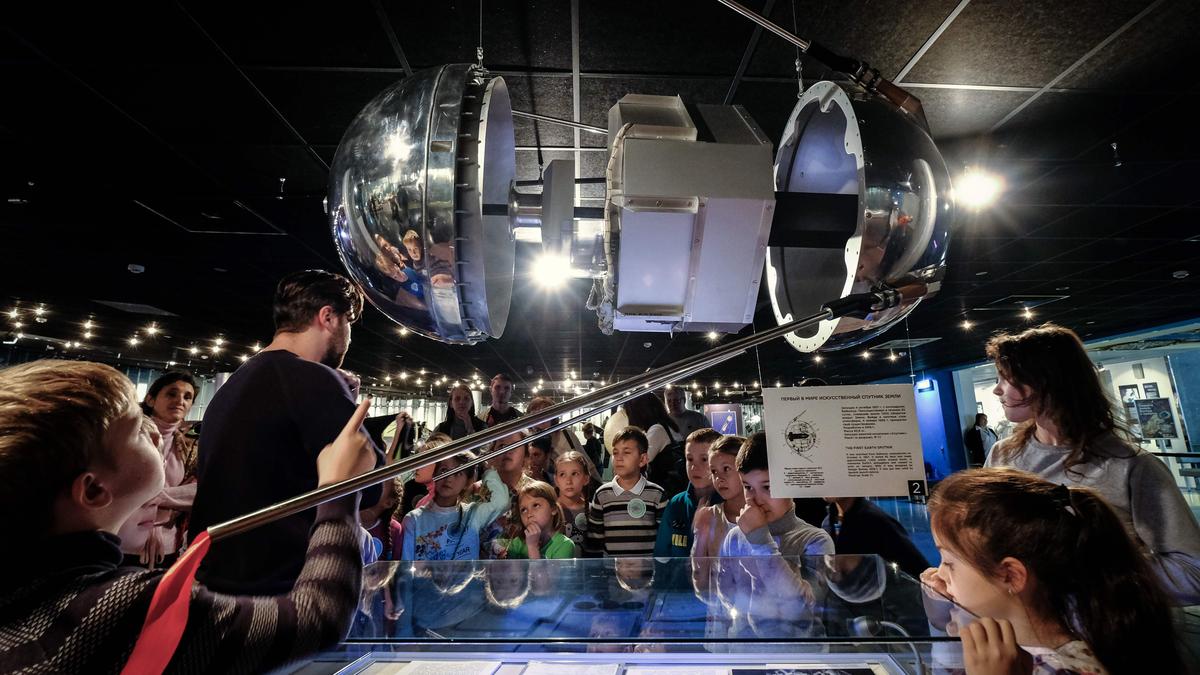
Picture dated October 4, 1957 shows the world’s first artificial satellite, Sputnik. Wavery and high-pitched, the beep-beep signal picked up on Earth signalled the dawn of a new era.
| Photo Credit:
AFP
On October 4, 1957, the Soviet Union launched the Sputnik — Russian word for “fellow traveller” — at 10:29 p.m. Moscow time from the Tyuratam launch base in the Kazakh Republic. At about the size of a basketball, the 22-inch metallic sphere circled the Earth once in less than 100 minutes (95-98 minutes).
The beeps that mattered
With a low-power radio transmitter being the only cargo on board, it broadcast a beeping noise regularly. These beeps were picked up by amateur radio operators throughout the world, and it was heard for the first time in India at Madras (now Chennai) at 4:12 p.m. on October 5.
Until its battery ran out on October 26, for 22 days Sputnik transmitted its distinctive radio signal. As the initial expectations had only been for a couple of weeks, the battery life actually outdid what was planned, offering radio operators throughout the world more opportunities to track the satellite.
Orbiting the Earth at 29,000 km per hour, the Sputnik had an elliptical orbit with an apogee (farthest point from Earth) of about 940 km and a perigee (nearest point) of nearly 230 km. In addition to being picked up by radio listeners across the globe, it was also visible with binoculars before sunrise or after sunset when in the vicinity.
Sputnik’s orbit started deteriorating in January 1958 and, as expected, the spacecraft burned up while re-entering the Earth’s atmosphere on January 4. By then, the satellite had orbited the planet for 92 days, travelling over 70 million km.
In addition to the success in terms of the science and technology involved, the launch carried a lot of political mileage for the Soviets and it marked the opening salvo in another phase of their Cold War against the U.S.
Korolev’s contribution
Soviet engineer Sergei Korolev spearheaded their effort in the space race. Having headed the design of the first intercontinental ballistic missile, the Soviet R-7, he also oversaw the R-7 rocket’s launch of the Sputnik 1 (while Sputnik usually refers to Sputnik 1, there are other Sputniks, including Sputnik 2, which was launched in November 1957, and Sputnik 3, launched in May 1958).
The R-7 rocket’s design was based on Germany’s V2 rocket, a weapon that had been used by them in World War II. When the war was about to end, both the U.S. and the Soviets had been after the technology behind V2 and those who had helped design it. Even though most of V2’s design team, including its head and aerospace engineer Wernher von Braun, chose the U.S., the Soviets too picked up some parts and designs of V2. Russian aerospace engineer Konstantin Tsiolkovsky had also laid the ground work for the Soviet cause with his pioneering rocket work.
The success of the Sputnik meant that the battle lines were drawn for the first space race in human history. The Soviets did the bulk of the lifting initially, ticking a lot of firsts late in the 1950s and through much of the 1960s. The Americans, however, had the last laugh so as to say, as they landed the first human beings on the moon with their successful Apollo lunar landing programme.
What happened because of Sputnik’s success?
Birth of NASA
The world order at the end of World War II placed the U.S. at the apex. Sputnik’s success, however, shattered the belief of Americans that they were technologically (and in every other sphere, for that matter) superior to the rest of the world.
By the end of January 1958 — the month when Sputnik came crashing down — Explorer, the first U.S. satellite was launched. But with the Soviets having already launched Sputnik 2 on November 3, 1957 — and that too with the dog Laika on board — the Americans felt that they had ceded ground to the Soviets. Not just in terms of space exploration, but also in terms of defence and military capabilities.
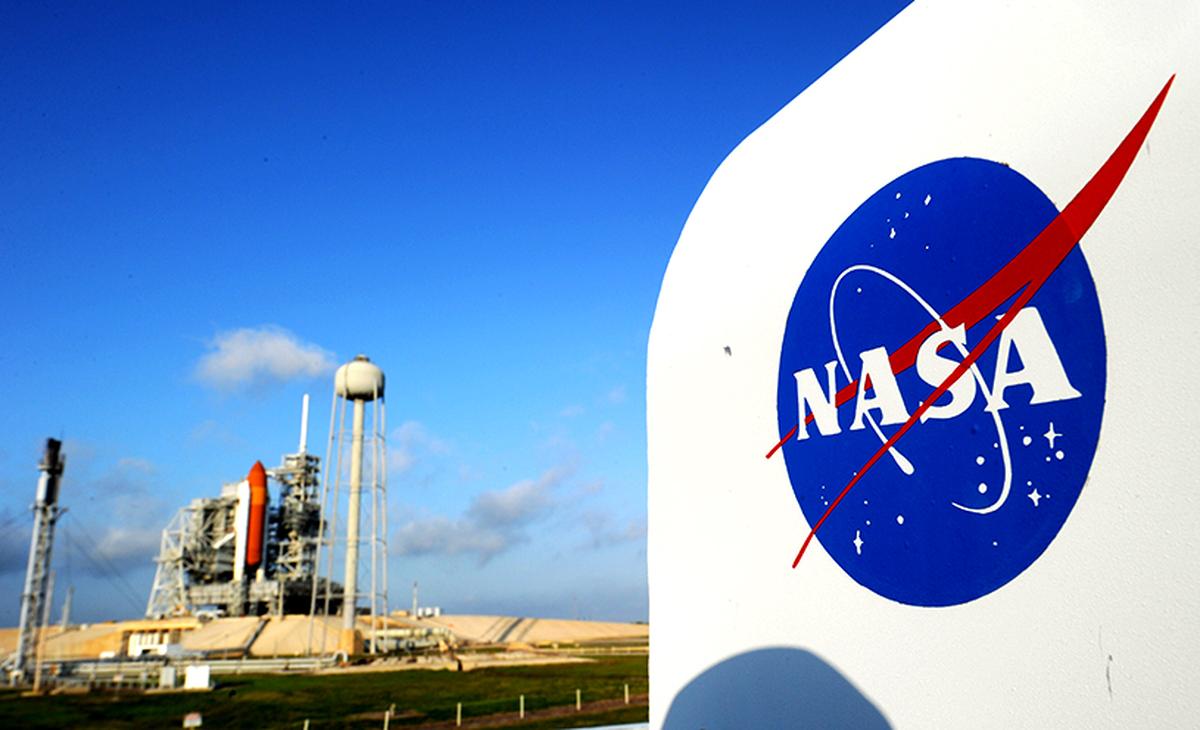
NASA is now almost synonymous with space exploration. NASA, however, came into existence only because Sputnik happened.
| Photo Credit:
STAN HONDA / AFP
The need of the hour, they felt, was the united effort of the U.S. government, its military, and the scientific community to catch up with the Soviets. Less than a year from the launch of the Sputnik, U.S. President Dwight Eisenhower created the National Aeronautics and Space Administration (NASA). The space race between the U.S. and the Soviet Union was officially underway.
Navigation by satellite
In the early days following the launch of the Sputnik, William Guier and George Weiffenbach, two Johns Hopkins University Applied Physics Laboratory (APL) scientists, began to track it. This tracking led them to determine the orbit of the artificial satellite by analysing the Doppler shift in its radio signals. This turned out to be a revolutionary method as it was the first successful means of tracking a satellite.
Dr. Frank T. McClure, a physicist at the APL, then made the bigger breakthrough by conceiving the inverse process. According to McClure, given that a satellite’s position was known and predictable, the Doppler shift of its signals could be used to locate a receiver on Earth. In case you are wondering to what use that might be put to, it lays the basis of navigation by satellites, the likes of which are used by almost everyone. In addition to conceiving the process, McClure also came up with the major components of an operational navigation system. The Transit Navigation Satellite System stemmed from these findings.

Be it ride-hailing apps, food delivery apps, or just navigations using maps, all of them are dependent on navigation by satellite.
| Photo Credit:
MURALI KUMAR K
All three of them were integral to the development of the Transit System, which was initially envisioned for the exclusive use of the military. Slowly, however, it evolved into a navigation system for all nations, serving basically as a forerunner to the now ubiquitous Global Position System. Every time someone turns on their location and uses it to go from one place to another, they are thus indirectly benefitting from Sputnik’s successful launch.