




A lifelong teacher and researcher
Born in Cranleigh, Surrey, England in 1877, G.H. Hardy came from a teaching family. Hardy’s first names were Godfrey Harold, but he never really used them, preferring the initials “G.H.” instead.
Hardy’s father was an administrator and art master at Cranleigh School, while his mother was a senior mistress at Lincoln Training College for teachers. Even though both his parents lacked a university education, they had a mathematical inclination that they certainly passed on to their son. Like many mathematicians, Hardy’s interest in the subject was evident early on and he was particularly fond of numbers, factors, and primes – interests that lasted a lifetime.
Following his schooling at Cranleigh, Hardy won a scholarship to Winchester College – for his mathematical work of course. He entered Trinity College, Cambridge, in 1896 and was offered a fellowship and then a teaching position. He started his working relationship with John Littlewood in 1910-11 and the duo went on to produce many mathematical papers together. He moved to Oxford at the end of World War I to become Savilian Professor of Geometry. He taught at Oxford for 10 years before returning to Trinity College, Cambridge, in 1929, where he spent the rest of his career.
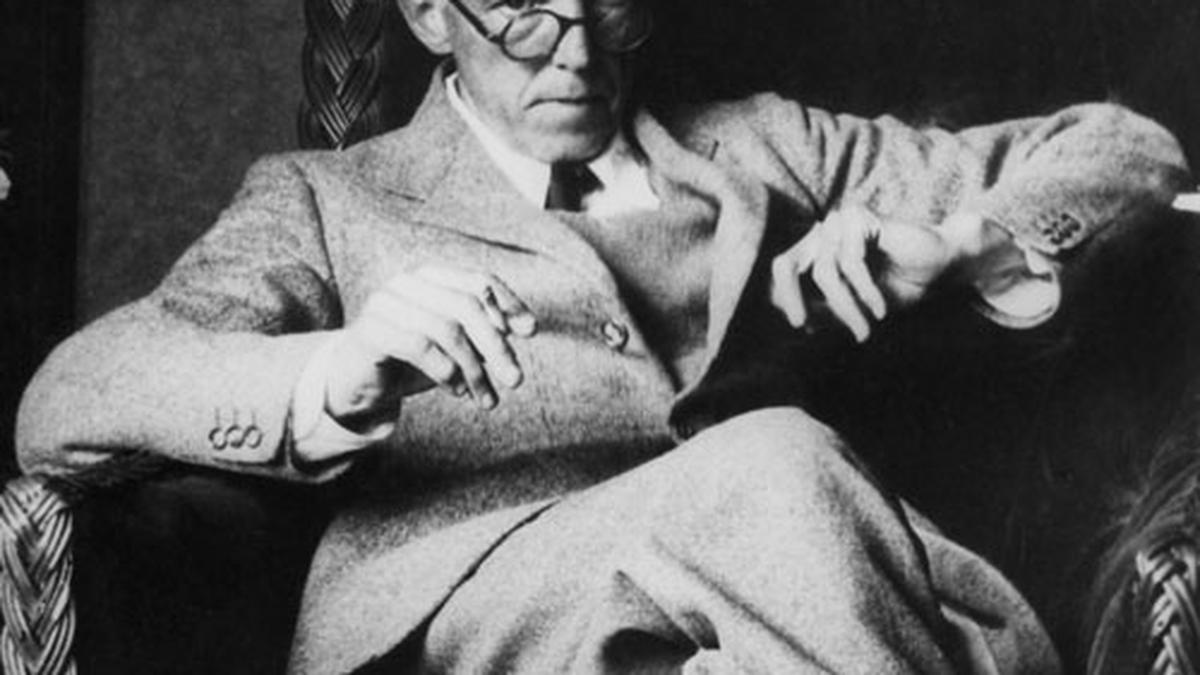
Having grown up as a shy and socially awkward child, Hardy was often cold and eccentric – characteristics that stayed with him throughout his life. He topped at school but found it difficult to accept the awards in front of everyone; remained uncomfortable about being introduced to new people even with age; and always disliked mirrors and photographs, explaining the dearth of finding good quality images of him even now. An avid cricket fan, Hardy often compared the quality of mathematical research according to the best batters of his generation.
Finding a hidden gem
Ramanujan was conferred a Trinity Fellowship in Cambridge. In this ceremonial picture, Ramanujan (centre) can be seen along with Hardy (right).
| Photo Credit:
Wikimedia Commons
Despite being a pure mathematician of repute himself, Hardy was effusive in his praise of Srinivasa Ramanujan – his student and mentee. Hardy even called his “discovery” of Ramanujan as his greatest achievement and described his association with the Indian as the “one romantic incident of [his] life.”
That Hardy and Ramanujan should collaborate was probably down to fate. It all started one morning early in 1913, when Hardy found, among the stack of letters on his breakfast table, a rather large, untidy one with Indian stamps. Now usually emails, scientists and researchers of considerable standing are used to receiving messages from unknown people making bold claims. Hardy himself wasn’t the only recipient of Ramanujan’s letters, but was the only one who chose to act on them. It is one thing to be a genius yourself. Quite another to spot the genius of another.
Having first glanced through the pages of equations without much enthusiasm, Hardy was bored and irritated as it did not include any proofs. He put aside the letters and went about his day’s work, only to keep thinking about some of the theorems as the day went by.
He sent word to his collaborator Littlewood that they must have a discussion at the earliest and by the end of the day the duo were closeted in Hardy’s room, poring over the manuscript. It didn’t take them long to recognise the ability of Ramanujan and by midnight they knew for certain that he was a genius. When Hardy later on came up with an informal 0-100 scale of natural mathematical ability, he gave himself 25, Littlewood 30, influential German mathematician and philosopher David Hilbert 80, and 100 for Ramanujan!
Hardy was instrumental in catapulting Ramanujan to global fame as he went out of his way to ensure that Ramanujan was brought to England. The two men were not only different in their cultural and economic upbringing, but also in the way they approached their mathematics. Wherein Hardy was rigorous with his proofs, Ramanujan didn’t even know what a proof meant to begin with. Hardy believed that he would have to “tame” Ramanujan, so as to say, and taught him the finer European ways of doing such things as providing proofs.
In addition to providing formal instruction and guidance, the two worked together and published several joint papers. Hardy also worked tirelessly to get recognition for Ramanujan, even after the latter’s death.
Hardy played his hand in ensuring that Ramanujan become a Fellow of the Royal Society and the first Indian Fellow of Trinity College. With his mentorship, Hardy served as a bridge for Ramanujan, whose intuitive brilliance might have otherwise been lost to the formal mathematical world. More than a century after Ramanujan’s death in 1920, his results are still being worked on and better understood.
A Mathematician’s Apology
In addition to his own work and mentoring Ramanujan, Hardy is also now remembered for his famous 1940 essay, A Mathematician’s Apology. This serves as a personal defence and reflection on the nature and aesthetics of pure mathematics.
In this, Hardy argues passionately about the beauty of pure mathematics and that it should be pursued for its intrinsic beauty and elegance, comparing it to an artform. Almost a lifelong collaborator, he speaks about his collaboration with both Littlewood and Ramanujan. He also expresses his belief that mathematical ability peaks in youth, calling it a “young man’s game”.
While it remains a work that affords a unique perspective into the mind of a pure mathematician, it has also received its fair share of criticism. A considerable part of what makes up the volume is now also perceived as the rants of a snobbish, elitist Englishman, and sections of it have misogynistic undertones.
It needs to be taken into account that Hardy wrote this closer to the end of his life, when he was in his 60s. He surely wasn’t at the best of his faculties, and, in fact, was closer to the low points of his life than the peaks – his mathematical abilities were waning and concern over his health were real.
The book is less than 100 pages long. If your curiosity is perked up by what you’ve read here, give it a read and take a stand for yourself.
Quote hanger
Here is a collection of quotes that give us an idea of how Hardy thought and worked…
I remember once going to see him when he was lying ill at Putney. I had ridden in taxi cab number 1729 and remarked that the number seemed to me rather a dull one, and that I hoped it was not an unfavorable omen. “No,” he replied, “it is a very interesting number; it is the smallest number expressible as the sum of two cubes in two different ways.”
This is Hardy’s recollection of a particular conversation with Ramanujan, now the stuff of legends. 1729 (13 + 123 = 1729, 93 + 103 = 1729) is therefore referred to as the Hardy-Ramanujan number. The incident also led to such numbers being referred to as taxicab numbers, wherein the nth taxicab number Ta(n) is the smallest number representable in n ways as a sum of positive cubes.
It is possible that the life of a mathematician is one which precisely no reasonable man would elect to live.
Hardy, during his inaugural lecture at Oxford, 1919-20
Archimedes will be remembered when Aeschylus is forgotten, because languages die and mathematical ideas do not. “Immortality” may be a silly word, but probably a mathematician has the best chance of whatever it may mean.
Hardy in A Mathematician’s Apology, 1940
A mathematician, like a painter or poet, is a maker of patterns. If his patterns are more permanent than theirs, it is because they are made with ideas.
Hardy in A Mathematician’s Apology, 1940
A science is said to be useful if its development tends to accentuate the existing inequalities in the distribution of wealth, or more directly promotes the destruction of human life.
Hardy in A Mathematician’s Apology, 1940
I believe that mathematical reality lies outside us, that our function is to discover or observe it, and that the theorems which we prove, and which we describe grandiloquently as our “creations,” are simply the notes of our observations.
Hardy in A Mathematician’s Apology, 1940