

Skip to content
  • Facebook
  • X
  • Linkedin
  • WhatsApp
  • Associate Journalism
  • About Us
  • Privacy Policy
  • 033-46046046
  • editor@artifex.news
Artifex.News

Artifex.News

Stay Connected. Stay Informed.

  • Breaking News
  • World
  • Nation
  • Sports
  • Business
  • Science
  • Entertainment
  • Lifestyle
  • Toggle search form
  • UK Elections: Huge Win For Labour, Historic Loss For Rishi Sunak’s Party: Exit Poll World
  • Actor Prakash Raj Meets Sonam Wangchuk In Leh, Supports His Hunger Strike, Statehood For Ladakh Nation
  • Man dies in Australia after whale collides with boat World
  • Top Medical Body Suggests Dos And Don’t For Doctors’ Signboards, Prescriptions Nation
  • FIBA Asia Cup Qualifiers: India Go Down Fighting Against Iran Sports
  • Digging A Pit Every 2 Days, How This Parched Rajasthan Village Gets Water Nation
  • Coca Cola bottler SLMG Beverages sets up ₹700-cr. plant in Amethi to cater to summer demand Business
  • Rupee Falls 9 Paise To Settle At Lifetime Low Of 83.22 Against US Dollar Business

Research discovers ancient Egyptian remains smell nice

Posted on February 17, 2025 By admin


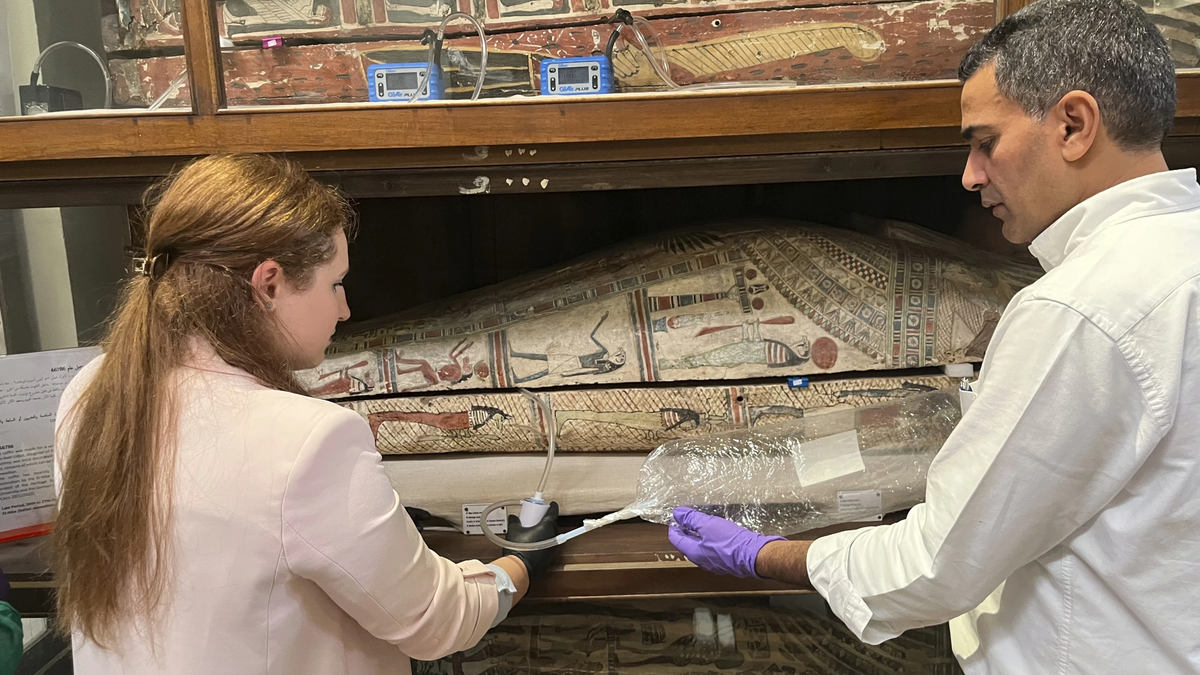
In this undated photo provided by Abdelrazek Elnaggar, Emma Paolin, PhD student at University of Ljubljana, sets up active air sampling with sorbent tubes and pumps.
| Photo Credit: Abdelrazek Elnaggar/AP

At first whiff, it sounds repulsive: sniff the essence of an ancient corpse.

But researchers who indulged their curiosity in the name of science found that well-preserved Egyptian mummies actually smell pretty good.

“In films and books, terrible things happen to those who smell mummified bodies,” said Cecilia Bembibre, director of research at University College London’s Institute for Sustainable Heritage. “We were surprised at the pleasantness of them.”

“Woody,” “spicy” and “sweet” were the leading descriptions from what sounded more like a wine tasting than a mummy sniffing exercise. Floral notes were also detected, which could be from pine and juniper resins used in embalming.

The study published Thursday in the Journal of the American Chemical Society used both chemical analysis and a panel of human sniffers to evaluate the odors from nine mummies as old as 5,000 years that had been either in storage or on display at the Egyptian Museum in Cairo.

The researchers wanted to systematically study the smell of mummies because it has long been a subject of fascination for the public and researchers alike, said Bembibre, one of the report’s authors. Archeologists, historians, conservators and even fiction writers have devoted pages of their work to the subject — for good reason.

Scent was an important consideration in the mummification process that used oils, waxes and balms to preserve the body and its spirit for the afterlife. The practice was largely reserved for pharaohs and nobility and pleasant smells were associated with purity and deities while bad odors were signs of corruption and decay.

Without sampling the mummies themselves, which would be invasive, researchers from UCL and the University of Ljubljana in Slovenia were able to measure whether aromas were coming from the archaeological item, pesticides or other products used to conserve the remains, or from deterioration due to mold, bacteria or microorganisms.

“We were quite worried that we might find notes or hints of decaying bodies, which wasn’t the case,” said Matija Strlič, a chemistry professor at the University of Ljubljana. “We were specifically worried that there might be indications of microbial degradation, but that was not the case, which means that the environment in this museum, is actually quite good in terms of preservation.”

Using technical instruments to measure and quantify air molecules emitted from sarcophagi to determine the state of preservation without touching the mummies was like the Holy Grail, Strlič said.

“It tells us potentially what social class a mummy was from and and therefore reveals a lot of information about the mummified body that is relevant not just to conservators, but to curators and archeologists as well,” he said. “We believe that this approach is potentially of huge interest to other types of museum collections.”

Barbara Huber, a postdoctoral researcher at Max Planck Institute of Geoanthropology in Germany who was not involved in the study, said the findings provide crucial data on compounds that could preserve or degrade mummified remains. The information could be used to better protect the ancient bodies for future generations.

“However, the research also underscores a key challenge: the smells detected today are not necessarily those from the time of mummification,” Huber said. “Over thousands of years, evaporation, oxidation, and even storage conditions have significantly altered the original scent profile.”

Huber authored a study two years ago that analyzed residue from a jar that had contained mummified organs of a noblewoman to identify embalming ingredients, their origins and what they revealed about trade routes. She then worked with a perfumer to create an interpretation of the embalming scent, known as “Scent of Eternity,” for an exhibition at the Moesgaard Museum in Denmark.

Researchers of the current study hope to do something similar, using their findings to develop “smellscapes” to artificially recreate the scents they detected and enhance the experience for future museumgoers.

“Museums have been called white cubes, where you are prompted to read, to see, to approach everything from a distance with your eyes,” Bembibre said. “Observing the mummified bodies through a glass case reduces the experience because we don’t get to smell them. We don’t get to know about the mummification process in an experiential way, which is one of the ways that we understand and engage with the world.”

Published – February 17, 2025 04:10 pm IST



Source link

Science

Post navigation

Previous Post: India Plans Vertical Take-Off Air Ambulances, IIT Startup Gets $1 Billion Deal
Next Post: Setback For Gautam Gambhir’s Protege At Champions Trophy, Compatriot ‘Way Ahead’ In Playing XI Race: Report

Related Posts

  • Scientists document remarkable sperm whale ‘phonetic alphabet’ Science
  • As sweltering summers ravage crops, Japan bets on heat-resistant rice Science
  • NASA names chief of UFO research; panel sees no alien evidence Science
  • Watch: ‘A great honour, privilege and opportunity’, says new ISRO chairman V. Narayanan Science
  • India is a powerhouse of mathematics, says Krishnaswami Alladi Science
  • 2023-24 El Nino among five strongest on record, will continue fuelling heat in 2024: WMO Science

More Related Articles

ISRO may postpone soft landing on Moon to August 27 based on health of lander module: Official Science
How will AI revolutionize drug development? Science
Gaganyaan astronauts | The chosen four Science
India celebrates first National Space Day Science
Study reveals history and oceanic voyages of remarkable baobab tree Science
Cotransplanting kidney, heart prevents heart transplant rejection Science
SiteLock

Archives

  • February 2025
  • January 2025
  • December 2024
  • November 2024
  • October 2024
  • September 2024
  • August 2024
  • July 2024
  • June 2024
  • May 2024
  • April 2024
  • March 2024
  • February 2024
  • January 2024
  • December 2023
  • November 2023
  • October 2023
  • September 2023
  • August 2023
  • July 2023
  • June 2023
  • May 2023
  • April 2023
  • March 2023
  • February 2023
  • January 2023
  • December 2022
  • November 2022
  • October 2022
  • September 2022
  • August 2022
  • July 2022
  • June 2022
  • May 2022

Categories

  • Business
  • Nation
  • Science
  • Sports
  • World

Recent Posts

  • Ukraine attack on Russian pipeline to hit Kazakh oil exports
  • Over 30 Injured As Firecrackers Explode At Football Ground In Kerala: Cops
  • Fly to Kolkata Now From Hindon, Air India Express Service Begins March 1
  • Devendra Fadnavis Directs Action Against “Objectionable” Wikipedia Content On Sambhaji Maharaj
  • Former UK PM Rishi Sunak, Family Visit Parliament House

Recent Comments

  1. dfb{{98991*97996}}xca on UP Teacher Who Asked Students To Slap Muslim Classmate
  2. "dfbzzzzzzzzbbbccccdddeeexca".replace("z","o") on UP Teacher Who Asked Students To Slap Muslim Classmate
  3. 1}}"}}'}}1%>"%>'%> on UP Teacher Who Asked Students To Slap Muslim Classmate
  4. bfg6520<s1﹥s2ʺs3ʹhjl6520 on UP Teacher Who Asked Students To Slap Muslim Classmate
  5. pHqghUme9356321 on UP Teacher Who Asked Students To Slap Muslim Classmate
  • Euro 2024: Belgium aims to emerge top of four-way Group E game against Ukraine Sports
  • Supreme Court’s YouTube Channel Restored After Hacking Nation
  • Preethi Pal’s Stunning Run That Earned India Historic 100m Medal At Paris Paralympics – Watch Sports
  • Rishi Sunak On Free Trade Deal With India Nation
  • RCB Make Bold Kohli Captaincy Decision After Talks With Gill Fail: Report Sports
  • U.K. debt hits 100% of GDP World
  • Aryna Sabalenka Beats Zheng Qinwen To Reach US Open Semi-Finals Sports
  • External Affairs Minister Jaishankar kick-starts nine-day visit to U.S. World

Editor-in-Chief:
Mohammad Ariff,
MSW, MAJMC, BSW, DTL, CTS, CNM, CCR, CAL, RSL, ASOC.
editor@artifex.news

Associate Editors:
1. Zenellis R. Tuba,
zenelis@artifex.news
2. Haris Daniyel
daniyel@artifex.news

Photograher:
Rohan Das
rohan@artifex.news

Artifex.News offers Online Paid Internships to college students from India and Abroad. Interns will get a PRESS CARD and other online offers.
Send your CV (Subjectline: Paid Internship) to internship@artifex.news

Links:
Associate Journalism
About Us
Privacy Policy

News Links:
Breaking News
World
Nation
Sports
Business
Entertainment
Lifestyle

Registered Office:
72/A, Elliot Road, Kolkata - 700016
Tel: 033-22277777, 033-22172217
Email: office@artifex.news

Editorial Office / News Desk:
No. 13, Mezzanine Floor, Esplanade Metro Rail Station,
12 J. L. Nehru Road, Kolkata - 700069.
(Entry from Gate No. 5)
Tel: 033-46011099, 033-46046046
Email: editor@artifex.news

Copyright © 2023 Artifex.News Newsportal designed by Artifex Infotech.