


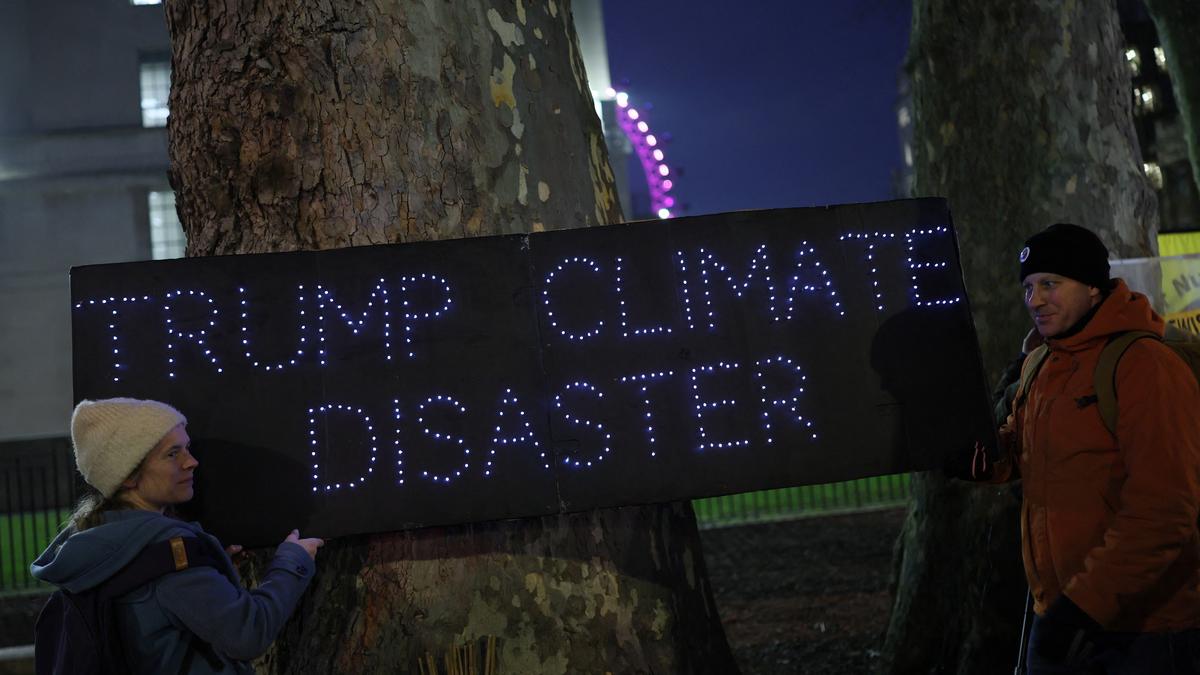
Demonstrators hold a placard that reads “Trump Climate Disaster” during a protest against the inauguration of Donald Trump as U.S. President.
| Photo Credit: Reuters
The story so far:
Among the first executive orders that Donald Trump signed after taking over as President on January 20 was to withdraw the U.S. from the Paris Agreement of 2015. This makes it the third time the U.S. has withdrawn from a treaty signed under the United Nations Framework Convention on Climate Change (UNFCCC).
What is the history of U.S. engagement with climate treaties?
The first time the U.S. withdrew from a climate agreement was in 2001 when President George W. Bush exited the Kyoto Protocol, adopted in 1997. This agreement was significant as it was the first time 37 industrialised countries had binding targets to lower carbon dioxide emissions. However, Mr. Bush withdrew the U.S., on the grounds that it crimped the economy. “I oppose the Kyoto Protocol because it exempts 80% of the world, including major population centres such as China and India, from compliance, and would cause serious harm to the U.S. economy,” he wrote in a letter to Republican senators.
Editorial | An exit of bluster: On the U.S. and the climate change fight
When Mr. Trump first withdrew the U.S. from the Paris Agreement in 2017, his reasons were similar: “I was elected to represent the citizens of Pittsburgh, not Paris,” he said. “The Paris deal hamstrings the U.S. while empowering some of the world’s top polluting countries… That is not going to happen while I am President.” Exiting the agreement meant the U.S. would cease to implement its targets to cut emissions and contribute to the ‘green climate fund,’ — a corpus to help climate-vulnerable countries adapt to climate change. In the new order, eight years later, he says that the Paris Agreement “… steered American taxpayer dollars to countries that do not require, or merit, financial assistance in the interests of the American people.”
However, when the U.S. withdrew in 2017, it did not practically result in an ejection. Technicalities in the drafting of the Paris Agreement meant that it would take a signatory country three years to withdraw and an extra year, intimating the United Nations governing body. This meant that by the time the withdrawal took effect in November 2020, Joe Biden had already been elected the 46th U.S. President; and in January 2021, he promptly signed the U.S. back in. The Paris Agreement committed all countries to collectively strive to keep temperatures from exceeding 1.5 degrees Celsius or pre-industrial times, failing which to certainly keep it below 2 degrees Celsius. Unlike Mr. Trump’s 2017 order, his latest order will withdraw the U.S. within a year.
How does the U.S. view climate agreements?
Until 2006, the U.S. was the world’s largest emitter of greenhouse gases. As the world’s largest economy, its general attitude towards the European Union-backed climate pacts has been to project itself as solving the climate crisis but being non-committal towards taking the legally binding emission cuts that this entailed. Right from the first Conference of Parties in Bonn in 1995, the U.S. expressed discomfort with a fundamental axiom of the UNFCCC — the mother convention that gives treaties such as the Kyoto Protocol and the Paris Agreement meaning. This is because carbon dioxide concentrations in the atmosphere were largely due to historical emissions by developed countries, it was incumbent on them to pay the bulk of the costs for clean-up.
It also translated to developing countries continuing on a fossil-fuel pathway. Due to discomfort expressed by major fossil fuel economies — the U.S., Australia, and Canada — ideas such as joint implementation (where countries earn credits for implementing clean energy projects in developing countries) surfaced. The U.S., despite having walked out of climate agreements, continues to send large delegations to the conference as ‘observers’ and be closely involved in negotiations.
In 2005, at COP 11 in Montreal, Canada, the head of the U.S. delegation, as reported by The New York Times, walked out of the negotiations despite the U.S. not being part of the Kyoto Protocol at the time. To cut to the present, there is bipartisan support for not crimping oil and gas production in the U.S. Oil and gas production has risen under the Biden administration. The U.S. remains the world’s largest crude oil producer and achieved record production in 2023. The country is also the largest producer of gas and, in 2022, became the world’s largest exporter of liquefied natural gas. Mr. Trump has committed to adding to this already substantial base.
Despite all this, the U.S. is critically short of achieving its greenhouse gas emissions target. As of 2022, the U.S. has achieved only about one-third of its 2030 emissions reduction goal. In the last weeks of his presidency, Mr. Biden increased the U.S. emissions reduction commitments to 61%-66% of 2005 levels by 2035.
Also Read | Trump’s exit from Paris Agreement ‘threatens’ future of renewable energy
What will be the fallout of the U.S. exit?
The U.S. has only exited the Paris Agreement, not the overarching UNFCCC. Several analysts have pointed out that the scale of investments in renewable energy, including private finance from the U.S., have vastly grown since 2017. Unlike India, China, and Indonesia — large developing economies dependent on coal — the U.S. is less reliant on it. The U.S. has historically supported the EU on anti-coal positions in climate negotiations.
Mr. Trump’s espousal of a ‘Drill, baby, drill!’ motto encourages more fracking and oil-and-gas drilling, which previous dispensations have only modestly slowed.
A U.S. exit might lead to developing countries taking on less ambitious targets, but given that climate targets have not managed to slow down global emissions, the U.S.’s exit at this point means little.
Published – January 26, 2025 02:35 am IST